Inhaltsangabe
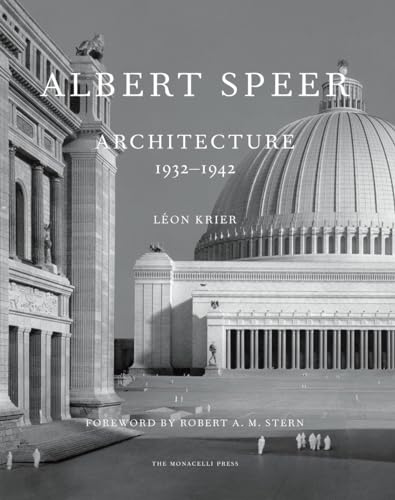
Architect Léon Krier asks, “Can a war criminal be a great artist?” Speer, Adolf Hitler's architect of choice, happens to be responsible for one of the boldest architectural and urban oeuvres of modern times.
First published in 1985 to an acute and critical reception, Albert Speer: Architecture 1932-1942 is a lucid, wide-ranging study of an important neoclassical architect. Yet is is simultaneously much more: a philosophical rumination on art and politics, good and evil. With aid from a new introduction by influential American architect Robert A. M. Stern, Krier candidly confronts the great difficulty of disentangling the architecture and urbanism of Albert Speer from its political intentions.
Krier bases his study on interviews with Speer just before his death. The projects presented center on his plan for Berlin, an unprecedented modernization of the city intended to be the capital of Europe.
Die Inhaltsangabe kann sich auf eine andere Ausgabe dieses Titels beziehen.
Über die Autorin bzw. den Autor
Born in 1946, Léon Krier is one of the most influential architects teaching and writing today. He has taught architecture and urbanism at the Royal College of Arts in London, and in the United States at Princeton University, Yale University, the University of Notre Dame, and the University of Virginia. He has worked extensively in Europe and North America and is currently consulting on projects in Guatemala, Romania, England, Belgium, Italy, France, and the United States. In 2003, he received the inaugural Richard Driehaus Prize for Classical Architecture.
Robert A. M. Stern is the founding partner of Robert A. M. Stern Architects and dean of the Yale School of Architecture. He is the author of the monumental five-volume history of New York’s architecture and urban development, culminating with New York 2000. Major current architectural projects include the new residential colleges at Yale University and the George W. Bush Presidential Center in Dallas.
Von der hinteren Coverseite
Author Leon Krier asks, "Can a war criminal be a great artist?" To answer affirmatively, Krier shows that Albert Speer, Adolf Hitler's architect of choice, is responsible for one of the boldest architectural and urban oeuvres of modern times. Krier bases his study of this seminal classical designer on a series of interviews with Speer. The projects presented center on Speer's plan for Berlin, an unprecedented modernization of the city intended to be the capital of Europe. In addition to the urban plan, Speer designed buildings for major institutions and agencies, including the monumental Great Hall, Hitler's Palace, the High Command of the Armed Forces, the New Chancellery, and the Triumphal Arch. Illustrations are drawn primarily from Speer's personal archivethis facsimile edition, Krier candidly confronts the great difficulty of disentangling the architecture and urbanism of Albert Speer from its political intentions. This difficulty notwithstanding, Krier's presentation is an important contribution to the study of classicism in architecture and architecture in affairs of state.
„Über diesen Titel“ kann sich auf eine andere Ausgabe dieses Titels beziehen.
Weitere beliebte Ausgaben desselben Titels

Suchergebnisse für Albert Speer: Architecture 1932-1942

Beispielbild für diese ISBN
Albert Speer: Architecture 1932-1942
Anbieter: Books From California, Simi Valley, CA, USA
Verkäuferbewertung 5 von 5 Sternen

hardcover. Zustand: Good. Zustand des Schutzumschlags: Includes dust jacket. Dust jacket has some wear and tear to it from shelfwear/ handling. Bestandsnummer des Verkäufers mon0003972906
Gebraucht kaufen
EUR 422,20
EUR 4,25 shipping
Versand innerhalb von USA
Versand innerhalb von USA
Anzahl: 1 verfügbar
Beispielbild für diese ISBN
Albert Speer: Architecture 1932-1942
Verlag:
The Monacelli Press, New York, 2013
ISBN 10: 1580933548
ISBN 13: 9781580933544
Gebraucht
Hardcover
Anbieter: Recycle Bookstore, San Jose, CA, USA
Verkäuferbewertung 4 von 5 Sternen

Hardcover. Zustand: Fine. Zustand des Schutzumschlags: Fine. Book is like new. Dust jacket is in a removable protective mylar cover. Bestandsnummer des Verkäufers 1035048
Gebraucht kaufen
EUR 438,77
EUR 4,90 shipping
Versand innerhalb von USA
Versand innerhalb von USA
Anzahl: 1 verfügbar
Foto des Verkäufers
Albert Speer : Architecture 1932-1942 by Leon Krier (2013, Hardcover)
Verlag:
Monacelli Press, Incorporated, 2013
ISBN 10: 1580933548
ISBN 13: 9781580933544
Gebraucht
Hardcover
Anbieter: Weston's Book Haven, Weston-super-Mare, Vereinigtes Königreich
Verkäuferbewertung 5 von 5 Sternen
Hardcover. Zustand: Good. Bestandsnummer des Verkäufers ALBE-102725-045
Gebraucht kaufen
EUR 410,57
EUR 36,62 shipping
Versand von Vereinigtes Königreich nach USA
Versand von Vereinigtes Königreich nach USA
Anzahl: 1 verfügbar
Beispielbild für diese ISBN
Albert Speer: Architecture 1932-1942
Anbieter: Widney Manor Books, Solihull, MIDLA, Vereinigtes Königreich
Verkäuferbewertung 4 von 5 Sternen
Hardcover. Zustand: Near Fine. Zustand des Schutzumschlags: Very Good. Book is in near fine condition with a very good dustjacket. 272pp with b/w illustrations throughout. Bestandsnummer des Verkäufers 012145
Gebraucht kaufen
EUR 645,18
EUR 22,78 shipping
Versand von Vereinigtes Königreich nach USA
Versand von Vereinigtes Königreich nach USA
Anzahl: 1 verfügbar
Beispielbild für diese ISBN
Albert Speer: Architecture 1932-1942
Anbieter: thebookforest.com, San Rafael, CA, USA
Verkäuferbewertung 4 von 5 Sternen
Zustand: Good. Text block, boards and binding are pristine. Dust wrapper in fine, like new condition. Previous library copy with usual markings/stickers or stamps. Well packaged and promptly shipped from California. US veteran operated. Bestandsnummer des Verkäufers BAY_01_SH_022117
Gebraucht kaufen
EUR 748,33
EUR 3,40 shipping
Versand innerhalb von USA
Versand innerhalb von USA
Anzahl: 1 verfügbar
Beispielbild für diese ISBN
Albert Speer: Architecture 1932-1942
Anbieter: Toscana Books, AUSTIN, TX, USA
Verkäuferbewertung 5 von 5 Sternen
Hardcover. Zustand: new. Excellent Condition.Excels in customer satisfaction, prompt replies, and quality checks. Bestandsnummer des Verkäufers Scanned1580933548
Neu kaufen
EUR 2.258,71
EUR 3,66 shipping
Versand innerhalb von USA
Versand innerhalb von USA
Anzahl: 1 verfügbar